ANR CANELONI : Multi-scale approach to bio-inspired hybrid systems for nanofiltration and iontronics
ANR CANELONI (ANR project : 2025-2029)
Coordinator :
- François Henn, L2C, Montpellier
Partners :
- L2C, Université de Montpellier-CNRS
- IBMM, Université de Montpellier-CNRS
- Laboratoire de Nanomédecine, Imagerie, Thérapeutique, Université de Marie et Louis Pasteur, Besançon
- NIMBE-LEDNA, IRAMIS/CEA-Univ Paris-Saclay
- ILL, Grenoble
Project goal :
Synthetic nanopores remain, to date, far less efficient than the biological ion channels (BICs) found in living cell membranes, which simultaneously provide high permeability and high selective transport of ions and water. Incorporating BICs into solid-state nanochannels could offer a pathway toward advanced nanoporous membranes or nanofluidic micro‑platforms built around a single nanopore. The range of potential applications is wide, spanning nanofiltration, artificial neurons, blue (osmotic) energy harvesting, and single‑molecule detection.
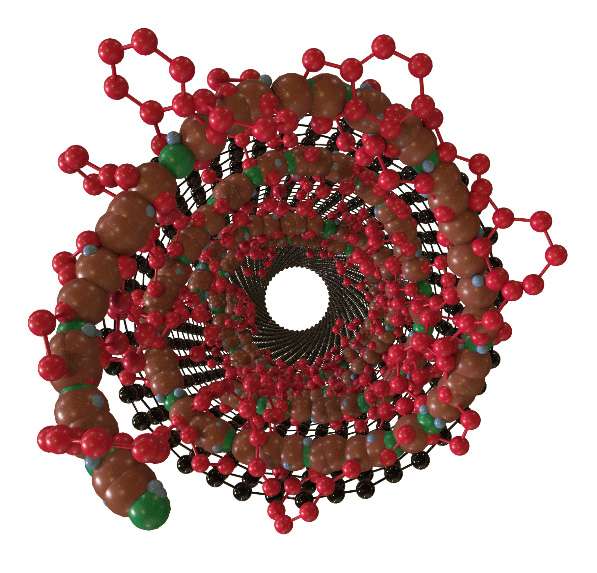
In this context, the CANELONI project aims to investigate the confinement of a biological ion channel — the peptide gramicidin A (gA) — within a single‑walled carbon nanotube (SWCNT).
Beyond this specific question, the project will also shed light on the feasibility of inserting this natural peptide into SWCNTs and on the preservation of its helical structure — and therefore its biological functionality — under confinement. To ensure that gA retains its β‑helical structure, a stapled‑gA analogue will be synthesized. In addition, new synthetic routes will be explored to improve the overall yield.
The study will combine experimental approaches and molecular modeling. Experimentally, the hybrid gA/SWCNT system will be synthesized and characterized using Raman spectroscopy, HRTEM, neutron and X‑ray spectroscopies, and water adsorption isotherms. The ionic conduction properties of the hybrid system will then be examined at two scales: within membranes composed of aligned CNT carpets, and within nanofluidic micro‑platforms constructed around a single SWCNT.
Molecular simulations will rely on classical force‑field molecular dynamics to probe the structure of the peptide as it enters and remains confined within the SWCNT. The simulation data will be compared with neutron spectroscopy measurements and will also be used to compute the ionic transport properties of the hybrid system.